

When to Start Teaching a Child to Count
Start too early and too formally and a child loses interest. Here's when counting is worth introducing, how to make it enjoyable, and what tends to get in the way.

When is the right moment to start teaching a child to count, and how do you make it enjoyable rather than a chore? Both questions are worth answering, but the value of counting comes first.
Counting underpins more than maths. It feeds problem-solving and logical thinking, and both matter well beyond the classroom. This article covers when to start, which teaching methods actually work, the challenges that come up, and what a parent can do to help.
Why Counting Matters for a Child
Counting gives a child the foundation for the more complicated maths that comes later. Learning it isn't only about recognising numbers, it builds logic, problem-solving and analytical skill.
Those are useful daily and across every other subject. Here's why it's worth the effort.
1. Cognitive Development
Counting builds the basic grasp of maths that sits at the centre of cognitive development. Children who start early tend to solve problems better and think more logically.
2. Understanding Time and Money
Counting also helps a child make sense of time and money. Once numbers mean something, they start understanding when it's time to sleep, to study and to play.
Money follows the same path. Recognising what things are worth is a skill they'll use constantly.
3. Getting Ready for School
Teaching counting early prepares a child for formal education. A child with a solid grounding copes far better when more complicated maths arrives.
Understanding the Stages of Development
Children move through distinct stages of cognitive development. In Jean Piaget's model, children between 2 and 7 are in the preoperational stage, where symbolic thinking develops and numbers and counting start to make sense.
This is when children first show interest in numbers and can begin counting simply. The concrete operational stage follows from around 7 to 11, when more abstract maths becomes reachable and children handle addition and subtraction, then multiplication and division.
When to Start
Counting can begin somewhere between 4 and 6, which is when most children start showing an interest in numbers and patterns. Every child develops at their own pace, though, so a flexible approach matters more than a fixed age.
Starting too early with something too academic tends to backfire. A child feels pressured and loses interest in learning altogether.
Introduce it gradually and keep it enjoyable. Number games, counting songs and everyday activities involving numbers all work well.
Teaching Methods That Work
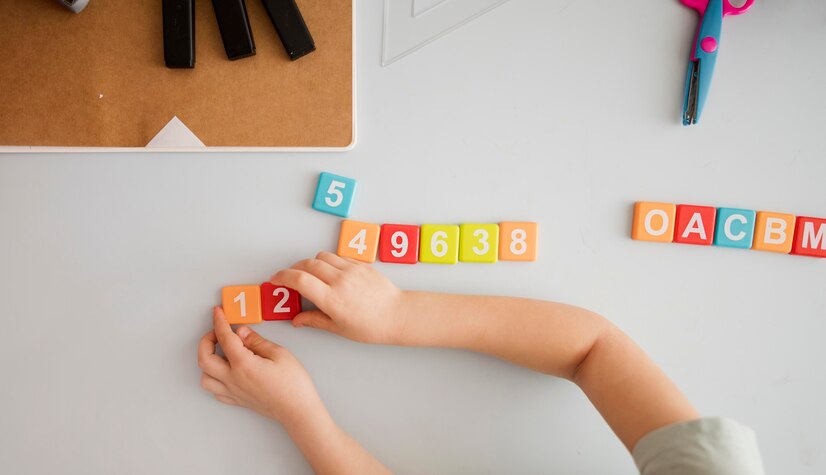
Several approaches work for teaching a child to count. These five are the most reliable.
1. Learning Through Play
Play is how children learn naturally. Toys involving numbers, number blocks, puzzles or board games that need counting, all teach it without feeling like teaching.
2. Learning Through Songs
Counting songs are an enjoyable and easy way to introduce numbers. The order sticks far more readily set to a tune than recited.
3. Everyday Activities
Bring your child into the counting that already happens, counting fruit while shopping, steps while walking, or plates at the table. Simple things like these show a child how numbers are actually used.
4. Apps and Digital Games
There are plenty of apps built specifically to teach counting. Most use interactive games and animation to hold attention, which makes the learning feel like playing.
5. Reading Books
Books are an effective route into counting. Plenty of them build numbers and counting into the story, which makes them a genuinely useful tool.
Build Their Confidence by Teaching Them to Socialise Early
What Tends to Get in the Way
The benefits are real, but so are the difficulties. Here are the three that come up most.
1. Whether They're Ready
Not every child develops at the same rate, and some take longer to grasp numbers than others. Don't push it, and give them the time they need.
2. Interest and Motivation
Some children simply aren't drawn to numbers. That calls for a more creative way in rather than more repetition.
3. Limited Resources
Not every parent has ready access to books and educational toys. If that's you, simple and effective alternatives are worth looking for, and most of them cost nothing.
What a Parent Can Do
A parent's part in this is significant. Building an environment that supports learning, with educational toys and books available, does much of the work on its own.
Praise and encouragement when your child finishes a counting task matter just as much. That's what builds the confidence to keep going.
Happy Kamper lists places to learn, grow and play, with prices and locations shown on each listing. You can filter by what's near you and read reviews from other parents before booking anything.
In Short
Counting is a foundational skill for a child's cognitive development, and the timing matters. Somewhere between 4 and 6 is when most children are ready, and that interest becomes the foundation for the maths that follows.
Enjoyable, interactive methods make it stick, whether that's play, songs or simply counting through the day together. A parent's patience and support do the rest.
Get the approach right and counting supports far more than school results. The problem-solving and logical thinking it builds stay useful for life, and you'll find activities that support it on the Happy Kamper app.