
Ten Things Playing Music Does for a Child
Language, memory, motor control, focus and confidence. Ten things playing music actually builds in a child.
Music is among the activities children take to most readily, and learning generally goes better with music behind it. There's a good deal that playing music does for how a child grows.
Introducing a child to music early is worth doing, so their development through those first years goes as well as it can. Here's what it actually builds.
1. Language Ability
The effect a child feels most clearly is on their language. Working through lyrics and melody, they pick up a considerably wider vocabulary.
Their intonation and articulation improve alongside, more or less automatically, through playing and singing. It happens without anyone teaching it directly.
2. Hand and Ear Coordination
Melody trains the coordination between a child's hands and their hearing. They have to make their brain work faster and more efficiently to keep up.
The instrument their ear registers then drives the hand movement that follows the rhythm. That loop is what the training actually is.
3. Memory
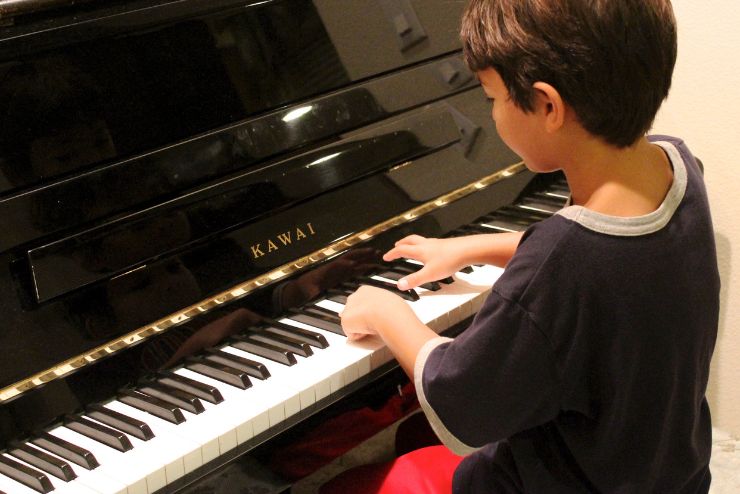
Playing music sharpens a child's memory. An instrument like guitar, piano or bass requires them to remember chords and scales.
Singing works the same way, since they have to know the lyrics and the melody for the result to sit properly against the instrument.
4. Thinking and IQ
Research at the University of Toronto found children who trained in voice and piano for a year showed a rise in IQ. Plenty of parents have long acted on the same belief, playing classical music to a child before birth.
Exposure to music is thought to stimulate brainwaves, which supports how a child's thinking develops.
5. Fine Motor Control
Playing guitar or piano trains a child's fine motor control. Both demand complex coordinated movement, which stimulates those skills directly.
Simpler things do it too. Clapping, dancing or even listening are all thought to improve a child's motor skills.
6. A Way to Express Themselves
Music also gives a child somewhere to put what they feel. They get used to expressing emotion through something positive rather than holding it in.
Music lets a child express a whole range, from happiness through to sadness. Once that becomes a habit, writing their own songs is a natural next step.
7. Creativity
Playing music is creative by nature, which is why the two are so closely linked. A child who enjoys playing tends to become more creative with it, whether that's writing lyrics or arranging a melody.
8. Focus and Concentration
An instrument like guitar, piano, bass or drums trains a child's focus on a single activity. Learning one demands concentration on notes and chords until the result sounds right.
Done regularly, that trains their focus and concentration well beyond the instrument itself.
9. Confidence
Learning an instrument teaches a child to see themselves as a musician. Playing a short piece through, performing with a group, or winning something all build their confidence further.
10. Social Interaction
Playing music with other children or a teacher trains a child's social skills automatically. Joining a band demands them, since a good performance depends on everyone working together.
Done regularly, that interaction sharpens considerably. It's one of the less obvious returns on learning an instrument.
Those are the main things a child gains from playing music. Taken together they make a strong case for introducing it early.
The straightforward way to support it is enrolling a child in music lessons, where the learning is structured and a teacher guides it. Happy Kamper lists music classes with locations and current prices shown.