
Kinesthetic Learning: Understanding the Child Who Can't Sit Still
Some children learn through their hands and feet, not by sitting still. How to recognise it, and what to do about it.
You've probably watched your child fail to sit still while learning. Hands always reaching for something, feet moving constantly, and at their most engaged when they're learning through play. That's often a sign of a kinesthetic learning style.
This style means a child absorbs things more easily through physical movement, direct experience and motor activity. For anyone looking for an approach that suits an active child, understanding it is a useful first step. Here's a closer look at how it works.
What Is Kinesthetic Learning?
Kinesthetic learning uses the body and movement as the main route for taking in information. Children who learn this way are usually more attuned to what they do physically than to what they only hear or see.
Thomas Armstrong, the education specialist and author of Multiple Intelligences in the Classroom, links this style closely to bodily-kinesthetic intelligence, the kind that shows in physical ability such as hand-eye coordination and general body control. Children with this intelligence tend to gravitate towards dance, sport or building something with their hands. Neil Fleming, who developed the VARK model of visual, auditory, reading/writing and kinesthetic modes, argues that kinesthetic learners understand a concept best when they're physically involved, whether through an experiment, hands-on practice or role play.
So if your child would rather get stuck in than sit still at a desk, they may well be a genuine kinesthetic learner. Knowing that changes how you approach everything from homework to weekend activities.
Signs of a Kinesthetic Learner
The question is how to tell a genuine kinesthetic learner from a child who is only temporarily restless. Here are the characteristic signs to look for.
A kinesthetic learner has a distinctive pattern. They like to move, to try things and to touch. They usually find it easier to concentrate when they're physically involved in what they're learning, and here are fifteen common signs.
- Remembers something more easily while moving or doing.
- Often touches an object or a learning aid while working.
- Likes taking things apart and putting them together.
- Uses their hands while explaining something.
- Learns better through practice than through theory.
- Can't sit still for long.
- Enjoys games involving the body, like sport or dance.
- Likes role play or drama.
- Struggles to concentrate on audio or text-only learning.
- Enjoys art involving their hands, like painting, threading or craft.
- Gets bored quickly without movement in the process.
- Tends to learn something by trial and error.
- Responds well to game-based learning.
- Prefers an experiment to a set of instructions.
- Grasps maths or science quickly when it's taught with physical aids.
If your child shows most of these, they're very likely a kinesthetic learner. Recognising it lets you start adjusting the approach so they stay enthusiastic and confident.
Why Supporting It Matters
Having recognised the signs, the next thing is understanding why it's worth supporting the way they learn. A child learning in the style that suits them develops better academically and emotionally alike. Here's what a child gains when a kinesthetic style is properly supported.
- Movement makes abstract concepts easier to grasp. Learning maths with blocks or a physical aid gets a child to number operations far more quickly.
- Active methods hold attention and stop boredom setting in. They never feel trapped in a monotonous routine, because there's always something physical to explore.
- Room to move leaves a kinesthetic child feeling valued and more confident. They stop being "the one who can't sit still" and become a child with a genuine strength in movement.
- Physical activity builds fine and gross motor skills at the same time. That matters for their physical development and their coordination.
- Active learning builds social skills and teamwork. Plenty of kinesthetic activities are collaborative, like a group game or a simulation, which trains social interaction naturally.
Understanding all this makes it easier to back your child's learning properly. It also makes it easier to explain to a teacher why the usual approach is not working.
How to Apply It at Home or at School
The next question is how to actually put it into practice. A kinesthetic style is flexible enough for formal lessons and relaxed learning alike. The key is giving a child room to move, touch, try and experience the process directly.
Here are three strategies worth trying.
1. Learning Through Interactive Play
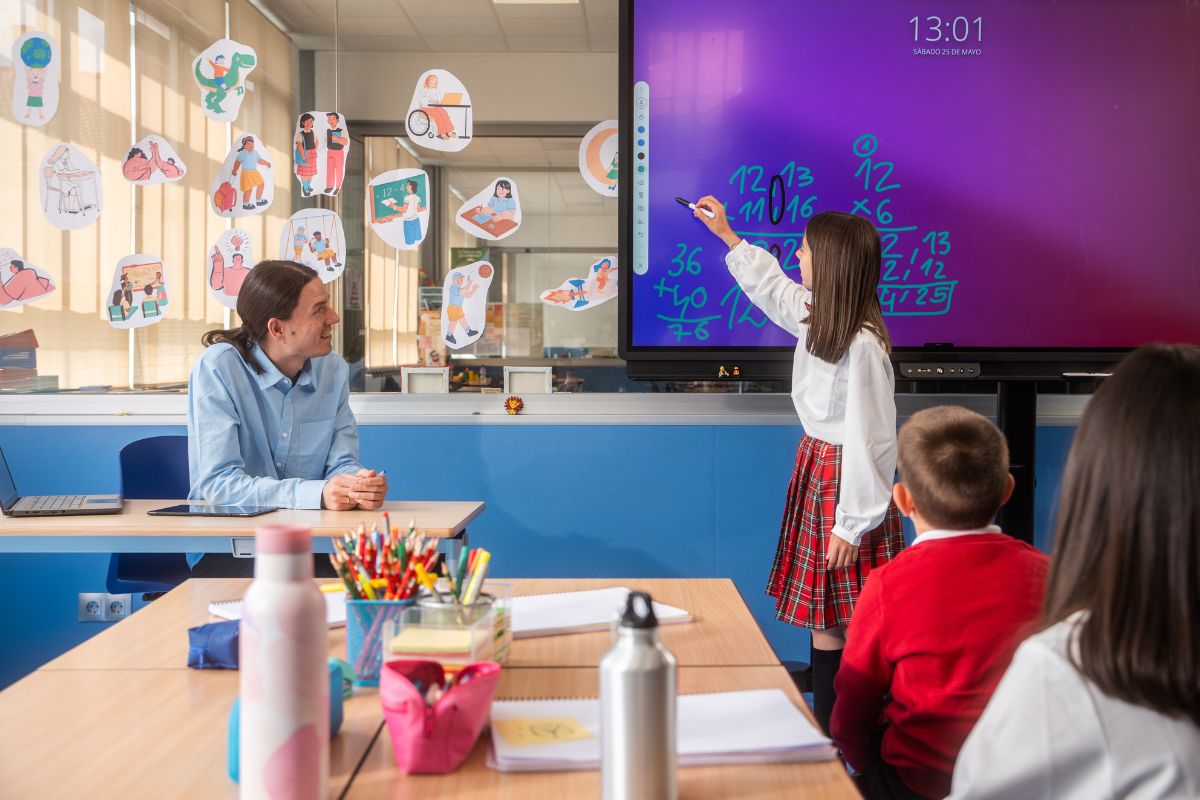
One of the most effective strategies is building play into the learning itself. A kinesthetic child learns far better playing than sitting and taking notes.
For letters or numbers, use letter blocks, alphabet cards or a puzzle. For English vocabulary, play Simon Says or guess-the-word with physical actions. Games like these help a child absorb information actively and enjoyably.
2. Use Physical Aids and Real Objects
Rather than explaining verbally, help a child grasp a concept with something visual and real. For science, try a simple experiment like a miniature volcano, and for maths use buttons, seeds or coloured blocks for counting.
This way a child learns while handling, arranging, moving and observing the object directly. It makes the process livelier and considerably easier to remember.
3. Build a Flexible Learning Space
Kinesthetic children often struggle to sit for long, so a rigid learning space works against them. Set out a play mat, a small table or a portable whiteboard. Let them learn standing, walking or even dancing, as long as it helps them focus.
Short, intense sessions with a break for movement in between work well. That keeps a child enthusiastic rather than mentally worn out.
The Challenges, and What to Do About Them
Enjoyable as it sounds, a kinesthetic approach has its own difficulties. One is the need for more space and equipment that supports physical activity. In a rigid school environment a kinesthetic child can be read as undisciplined simply for not sitting still.
The answer is starting at home with a flexible, dynamic learning routine. Bring the teacher or the school into a conversation about how your child learns. Make the case that a learning style isn't a behavioural problem but a strength worth building on, and a kinesthetic child in a supportive environment grows into an active, confident learner.
Understanding How a Child Learns Builds Confidence
Every child learns their own way, and for an active child who likes to move, a kinesthetic approach is the best route to developing properly. Recognising the signs and what they need lets you help them learn more effectively and more enjoyably.
To make it more engaging, it's worth exploring activities that suit this style. Happy Kamper lists pop-up classes that combine play with active learning, along with outdoor and outing activities that suit a kinesthetic child well.
So it's worth building a learning experience that matches how your child actually works. At home or at school, make sure they feel understood and have room to move, explore and learn their own way.