
Montessori Classes at Child Go Beyond
The five core Montessori principles, what the method builds in a child, and one provider running classes in Jakarta.
Younger children need the right teaching if they're going to develop well, which puts some work on a parent to find the method and activities that suit. A sensory or Montessori class is one option worth considering. Before looking at what's on offer, it helps to understand what the Montessori method is and where it puts its emphasis.
What Montessori Is
Montessori is an early years teaching method developed by Maria Montessori. It puts its emphasis on freedom and on a child exploring an activity themselves.
That's applied through group learning and a range of games. It's also thematic, so a child explores considerably more through it.
The defining feature is that children learn independently and decide what they want to learn. A child holds control over that rather than being pushed into it.
There are five core principles behind how it works. Here they are.
1. Learning Through Direct Experience
Maria Montessori believed children need to move and learn through direct experience. Turning up and listening to a teacher talk is not the method.
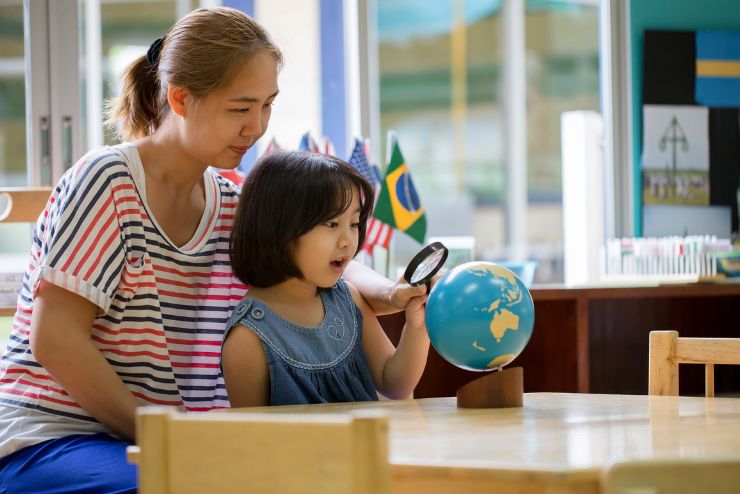
Montessori lets a child experience the learning directly. Learning arithmetic, for instance, a child doesn't only listen and memorise, they apply the counting themselves.
2. One-to-One Teaching
Every child has a different level of ability, so in Montessori a teacher adjusts to the child in front of them. Children aren't treated as interchangeable, since each has their own strengths.
3. The Teacher Presents the Material
In Montessori a teacher's job isn't only delivering material, it's observing and providing the right material at the right moment. They have to demonstrate directly and prompt a child into trying it.
4. A Child Chooses
Montessori lets a child choose what they want to learn. Language, sensory work, motor skills, maths, art and culture are all chosen by the child, so they learn deliberately rather than because they were told to.
5. A Classroom That Supports It
Finally, Montessori requires a space that supports exploration across topics. Layout, facilities and whether a child can reach things themselves all matter in building that room. Those five principles produce several advantages worth weighing when choosing a method for your child.
It builds confidence
A Montessori class built around a child's interests has a direct effect on their confidence. A child feels heard and recognised, which is what lifts it.
It lets a child develop at their own pace
With one-to-one teaching, each child is free to develop according to their own ability. They grow at a pace matched to their age and capability.
It develops potential early
Montessori also lets a child develop their potential early, since they choose the learning and activities that interest them.
Children enjoy learning more
Because a child is choosing deliberately, Montessori tends to leave them enjoying learning through the interactive activities involved.
It builds social skills
Social skills get trained too, since a child meets others of different ability and age. Over time they learn that everyone has their own strengths.
It teaches discipline
Montessori also trains discipline. That comes through the repetition of activities a child has chosen and committed to themselves.
With those principles and advantages, Montessori has drawn considerable interest from parents, whether in a school setting or as a pop-up class run at various venues. Child Go Beyond is one of the providers offering it.
Child Go Beyond is worth considering if you're looking for a Montessori class. It has run Montessori classes with a range of educational activities.
Child Go Beyond in Jakarta
For anyone looking for a Montessori class around Jakarta and Jabodetabek, Child Go Beyond is one answer. Based in Cikini and Pasar Senen in Central Jakarta, it has run Montessori classes for children from around 6 months to 7 years.
It has paid close attention to the detail of the learning, including the outcome. An after-class programme has given parents a report on how their child worked during the session. Parents have been involved in the learning too, since Montessori depends heavily on a parent creating the right environment at home for a child to explore in.
On some occasions parents have been brought in to learn alongside the teachers and specialists there. The point is keeping a child's development at home and in class aligned.
It has also offered several class formats. Here they are, though it's worth confirming what currently runs.
Class Options
- Regular class
A regular Montessori class suits anyone who wants their child learning consistently at the Cikini or Pasar Senen locations. This one has come with a report on what a child covered.
- Home visit class
Alongside classroom and themed pop-up sessions, Child Go Beyond has offered home visits for sensory and motor classes. That suits anyone wanting the Montessori method at home, with a teacher and facilitator visiting to run the session.
- Themed pop-up class
Pop-up classes have introduced children to sensory play around a theme, recommended for children from around 0 to 7. Themes have changed month to month, so it's worth checking what's currently scheduled.
Past Pop-Up Sessions
Themed pop-up sessions have run on set dates, generally starting mid-morning. Those dates have passed, so check Happy Kamper or the provider for what is currently scheduled and what a ticket costs.
For more detail on Child Go Beyond, their Instagram is @childgobeyond. That's the best place for current dates.
Other Montessori and sensory classes are listed on Happy Kamper with locations and current prices shown. It's worth comparing a few before booking.