
School Readiness in Indonesia: Is Your Child Ready for TK and SD?
A child is ready for TK or SD in Indonesia when they show age-appropriate skills across five developmental domains, namely cognitive, language and literacy, physical-motor, social-emotional, and self-care independence. TK entry typically happens at age 4 to 5 and SD entry at age 6 to 7.

What Does School Readiness Actually Mean in Indonesia?
School readiness is not about whether a 6-year-old can read, it is about whether they have the developmental foundation to benefit from formal schooling. In Indonesia, the transition to TK (Taman Kanak-Kanak) typically happens at age 4–5 and SD (Sekolah Dasar) at age 6–7. Both transitions are significant, but SD entry is the one where developmental gaps become most visible because the demands shift rapidly: longer sitting periods, more structured instruction, independent reading and writing, and larger peer groups.
The Indonesian national curriculum (Kurikulum Merdeka for early childhood) formally assesses six developmental domains. In practice, most parents and teachers focus on five that predict adjustment: cognitive, language and literacy, physical-motor, social-emotional, and self-care independence.
Domain 1: What Does Cognitive Readiness Look Like?
Cognitive readiness for TK entry (age 4–5) means the child can sort objects by colour, shape, and size; complete 4–6 piece puzzles; understand concepts like "bigger", "smaller", "same", and "different"; and follow 2-step instructions. By SD entry (age 6–7), cognitive readiness includes counting to 20 and recognising written numbers 1–10, identifying some letters of the alphabet in their first language, understanding basic cause-and-effect relationships, and solving simple classification problems (which one doesn't belong?).
Activities that build cognitive readiness start at home with sorting games, such as grouping coins by size or stacking cups by height. Educational apps with age-appropriate puzzles and maths-focused enrichment classes from age 5 extend the same skills.
Domain 2: What Language and Literacy Skills Does Your Child Need?
For TK: the child should be able to follow multi-step verbal instructions, hold a conversation with adults and peers, and express needs and feelings in words. For SD: reading readiness includes letter-sound awareness, the ability to rhyme, and recognising own name in writing. Full literacy is not expected by SD entry, the first two years of SD are explicitly designed to build it.
In Indonesian bilingual households, literacy readiness in Bahasa Indonesia is what matters most for formal schooling. Regional language fluency and English exposure are assets, but SD teachers assess Bahasa Indonesia literacy specifically.
Speech therapy is the fastest intervention for language delays identified at age 3–5. Happy Kamper lists education-focused enrichment providers who offer language stimulation classes specifically designed for pre-readers.
Domain 3: Physical and Motor Readiness
Gross motor readiness for school means the child can walk, run, hop on one foot, throw and kick a ball, and climb stairs alternating feet. Sitting still for 20–30 minutes, the length of a typical TK or SD lesson, requires core stability that many children have not fully developed by age 5.
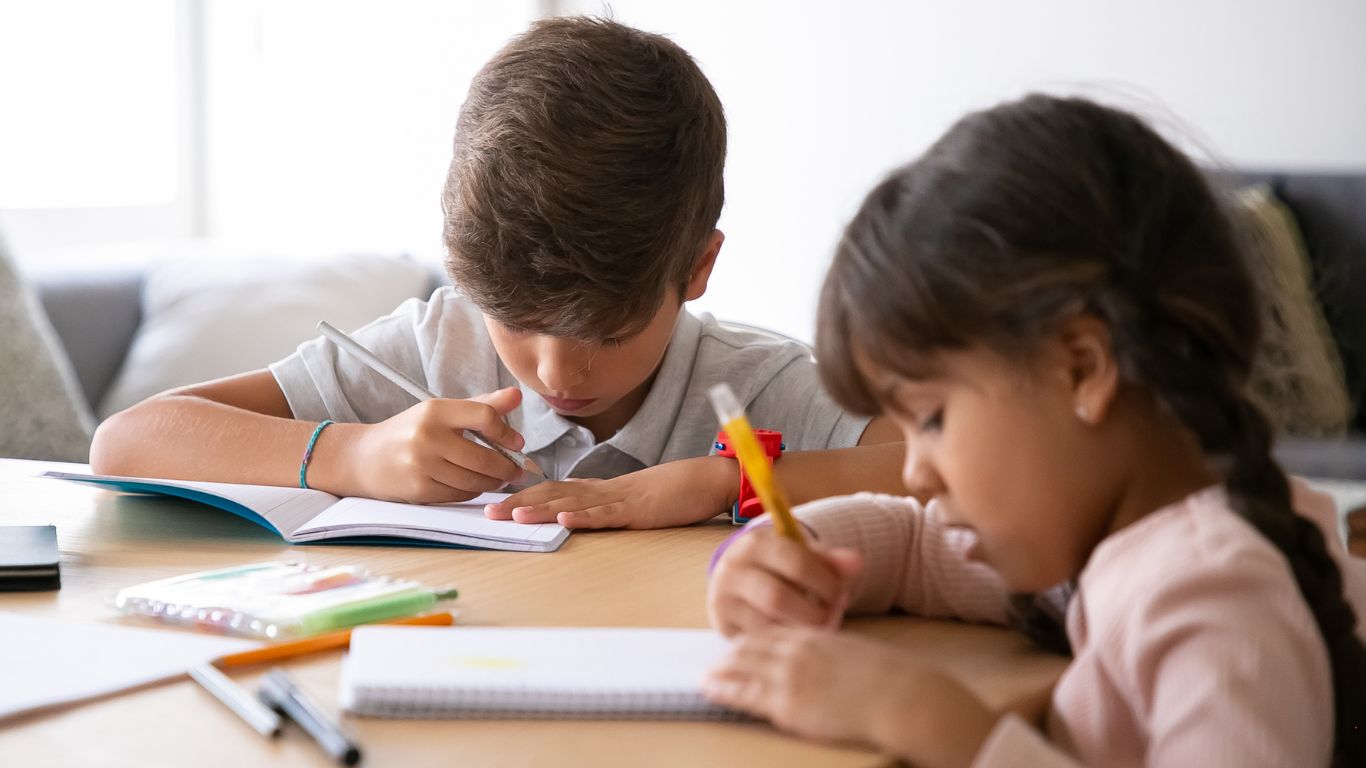
Fine motor readiness is increasingly important because both TK and SD involve significant pencil work from early on. Children who enter TK without adequate fine motor development struggle disproportionately with writing.
Key fine motor indicators: can hold a pencil with a 3-finger grip (not a fist grip), can draw basic shapes (circle, square, cross), can cut along a straight line with scissors, and can button and unbutton clothing. Sports, gymnastics, and art classes all build the combination of gross motor strength and fine motor control that physical school readiness requires.
Domain 4: Social-Emotional Readiness
This domain often determines first-year school adjustment more than any other. Social-emotional readiness means the child can separate from parents without prolonged distress (most of the time), follow group rules and take turns, interact positively with unfamiliar peers and adults, regulate frustration without hitting or aggressive outbursts (most of the time), and wait for their turn without constant adult mediation.
Children who struggle with separation anxiety or impulse regulation at school entry tend to experience more behavioural interventions in the first year, which creates a negative feedback loop. If your child has significant separation anxiety at age 5–6, a gradual TK exposure programme (shorter days that lengthen over 4–6 weeks) is more effective than a cold start. Group activity classes from age 3–4 onwards, sports teams, music groups, drama, are the best naturalistic setting for building social-emotional readiness.
Domain 5: Can Your Child Manage Self-Care Independently?
By SD entry, a child needs to manage basic self-care on their own. SD teachers in Indonesia manage 30–40 students per class.
They cannot assist individual children with basic self-care. A child who cannot independently manage their own toileting, open their lunchbox, put on their shoes, and pack their own bag will struggle, not because they are behind academically, but because their day is constantly interrupted by self-care challenges that distract from learning.
Self-care checklist for SD readiness: toilets independently and can clean up without adult help, and opens and closes lunchbox, drink bottle, and bag independently. The child should also be able to put on and remove shoes (velcro is fine, laces are not necessary) and communicate physical needs such as hunger, thirst, or needing the toilet to an adult.
Practise these skills at home 6–12 months before SD entry. If your child struggles with any of them, the issue is usually opportunity, they have not had enough practice, not that they are developmentally incapable.
How Can Happy Kamper's School Readiness Checklist Help?
Happy Kamper's free School Readiness Checklist tool covers all five domains with specific indicators for each. You select which skills your child has mastered, and the tool shows your overall readiness score per domain plus recommended activity categories to strengthen any gaps. The checklist is designed for children aged 4–7 and is calibrated to TK and SD entry standards in Indonesia.
If the checklist identifies gaps in physical readiness, visit the Activity Finder to find sports or gymnastics classes near you. Language gaps, look for education-focused enrichment providers.
Social-emotional gaps, group activity classes in any category help. The checklist is free, no account required, available at happykamper.io/en/tools/school-readiness.