
9 Places for Children's Music Lessons in Jakarta: What to Choose and Where to Start
Jakarta's directory lists nine children's music schools and they are spread thin. North Jakarta has three, south and west have two each, and central and east have one apiece. Almost every lesson is sold one to one rather than as a group class, so the choice you are making is lesson length and location, not class size.
The nine schools, and the parts of the city they leave empty
The directory lists nine music schools for children in Jakarta, and the map is lopsided. Three sit in the north, around Kelapa Gading, Sunter and the Kapuk Muara side of Pantai Indah Kapuk. Two are in the south near Kebayoran Baru and Kemang, two in the west around Kebon Jeruk and Central Park, and Jakarta Pusat and Jakarta Timur have one each.
That matters more for music than for most other kinds of class, because an instrument lesson is weekly and it continues for years rather than for a term. A drive you would accept once becomes a different question when you are making it every week.
The addresses also need reading carefully. One of the nine is registered outside Jakarta and teaches from a mall location inside it, so check the address of the branch your child would actually attend rather than the one on the profile.
Is your child getting a group class or a one-to-one lesson?
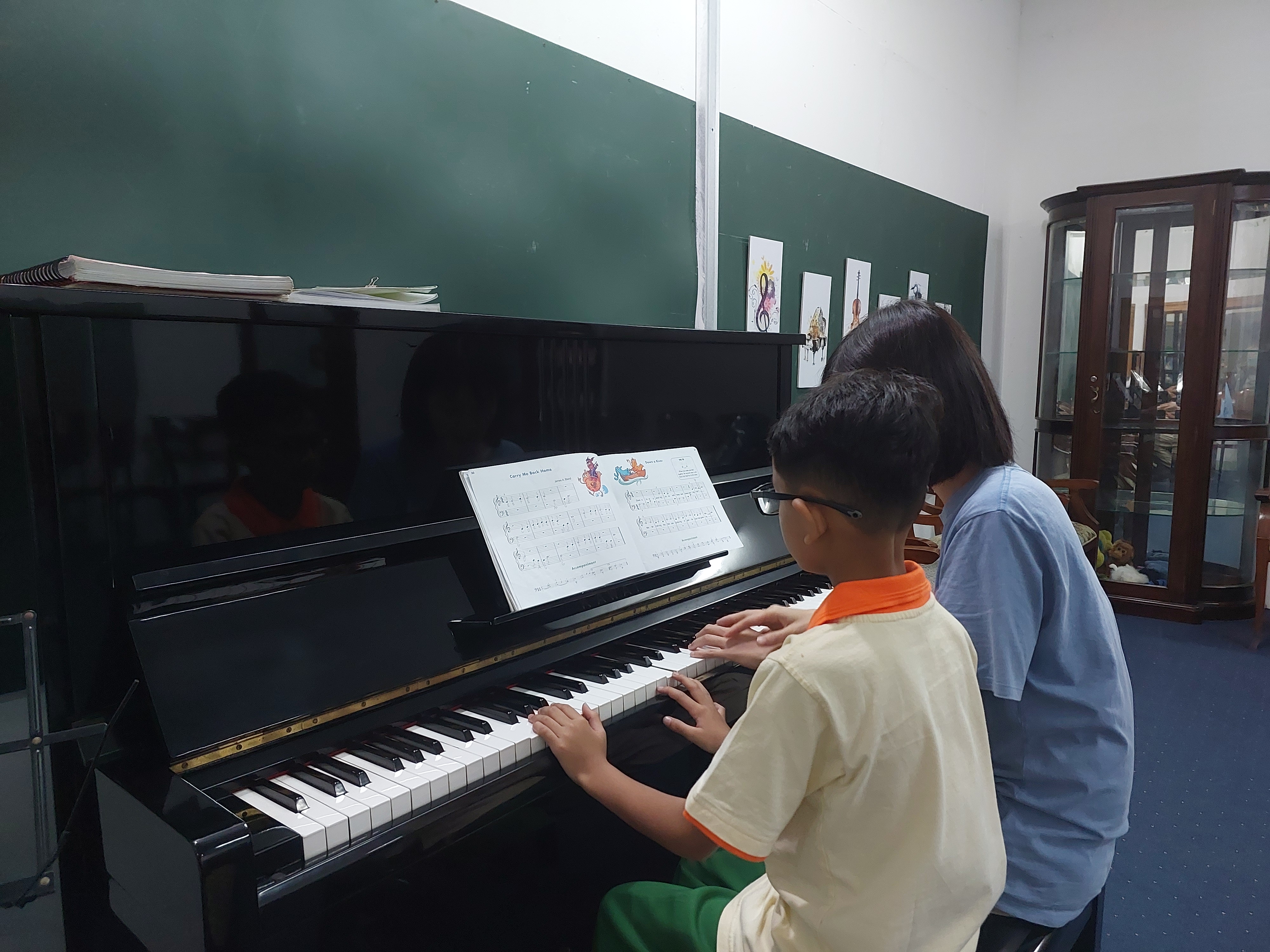
In Jakarta this is barely a choice. Almost every music listing in the directory is a private lesson, described as private, one by one, or a home visit, and the few group products on offer are choir, band and a parent and baby class rather than group instrument teaching.
Where a school does run group classes alongside private ones, the split is consistent. The group column holds singing, ensemble and dance, and every actual instrument sits in the private column.
That is worth knowing before you compare prices. A music fee that looks high next to a group dance or art class is usually buying one adult's undivided attention for the whole lesson, which is a different product rather than a worse deal.
Which instrument suits which age?
The age bands printed on the listings will not tell you. Most of the Jakarta schools publish the same band, 4 to 18, which is a filter for who may enquire rather than a statement about what a four year old and a fourteen year old are each taught.
The exceptions are the useful part. One listing is a babies and toddlers class starting from 0, one is a group class running from 2 to 14, and a third school sets its floor at 5 rather than 4.
Where a school does separate its instruments by age, violin starts later than piano, guitar and drum. The reason is physical rather than musical, since a violin has to fit the child's arm and is bought in fractional sizes and replaced as they grow, while a piano is the same size for everyone.
The practical move is to ignore the band and ask what the youngest current pupil on that instrument is. A school that teaches five year olds every week already has a method built for them, and that answer is more useful than the range on the listing.
Who supplies the instrument, the school or you?
Every Jakarta music listing in the directory is taught on site or at the pupil's home, and that difference decides the question. On site, the school's piano or drum kit is the one your child plays, and only the smaller instruments travel.
A home visit reverses it. Four of the nine will teach at the pupil's house, and a home piano lesson assumes a piano is already there, which turns the instrument into a purchase you make before the first lesson rather than after it.
So the order of the questions matters. Ask whether the fee includes use of the school's instrument, and separately whether the school expects one at home for practice, because a school can answer yes to the first and still expect the second.
Inside the monthly fee, and outside it
Most of the Jakarta prices are not per lesson. Five of the nine sell a block, usually four lessons across a month and in one case a pack of ten, so the figure on the listing is what you commit to at a time rather than what a single visit costs.
The variable that moves the price is lesson length, not the instrument. Where a school teaches several instruments they are often priced identically at the same duration, and moving from a half hour lesson to a full hour moves you up a whole tier rather than adding a small increment.
A home visit is priced as a tier above the equivalent on site lesson, which is the fee putting a number on the drive you were trying to avoid. Whether that is worth paying is a household calculation rather than a musical one, and the cost calculator is the quickest way to run it against the rest of the month.
Registration is the item most likely to surprise you. One school folds a joining fee into every package it lists, so the price shown is the price paid, while the rest quote tuition alone and bill the joining fee separately.
How much does a graded music exam add?
Exams are optional, and several of the Jakarta schools prepare pupils for them, most often the Trinity College London and ABRSM graded syllabuses. The fee is charged by the exam board rather than by the school, so it never appears in the tuition figure you were comparing.
For a sense of scale, I-MEC, which administers the Trinity exams in Indonesia, listed a Grade 1 practical exam at Rp1.410.000 on its 2026 fee schedule. Fees are set per grade and revised each year, so ask the school what an entry at the grade it is proposing costs before it steers you onto the ladder.
Two things about the boards are worth knowing first. Trinity sets no minimum or maximum age for its graded exams, and a candidate may enter at any grade without having passed the ones below it, so there is no queue your child has to join at a particular age.
The consequence is that the exam ladder is a choice rather than a syllabus you are signed up to. Some Jakarta schools also price their tuition by grade, so the monthly fee itself climbs as the child moves up, and that is a separate escalation from the exam fee.
A shortlist of three is the realistic best case
No part of the city gives you a wide field. Three schools in the north is the largest cluster, and three is a shortlist rather than a market, while a family in Jakarta Timur or Jakarta Pusat has one listed option and then a drive.
That changes what a first visit is for. With one school within reach the visit is not a comparison, it is a check on whether this teacher and this room work for your child.
The questions that earn their place are about what happens later, not about the first lesson. Ask what a missed lesson costs and whether it can be made up, ask how the fee changes as the child progresses, and ask whether the price includes the exam if the school expects one.
The Jakarta music and dance listings, each with its area, listed price, age band and booking link, are on the music and dance page for Jakarta. If nothing in your own part of the city fits, the activity finder filters by age and category across the whole city rather than by name.
1. Musico Music School
Available classes include Voucher Music Class, Modern Dance 10 -16 tahun, KPOP Dance 10-16 tahun. Programs for children aged 0 to 18. Listed from Rp150.000 per session. Rated 5 from 24 parent reviews. See the profile and class schedule.
2. Prelude Music School
Available classes include Private Vocal Class, Private Violin Class, Private Guitar Class. Programs for children aged 3 to 18. Listed from Rp500.000 per voucher. Rated 5 from 11 parent reviews. See the profile and class schedule.
3. Interval Music Indonesia
Available classes include Private Piano Class (Home Visit). Programs for children aged 5 to 18. Listed from Rp300.000 per voucher. Rated 5 from 10 parent reviews. See the profile and class schedule.
4. Wood Block Music & Art School – Jakarta Barat
Available classes include FREE TRIAL Music Class, Private Music Class - Level Advance, Private Music Class - Level Intermediate. Programs for children aged 4 to 18. Listed from Rp60.000 per session. Rated 5 from 8 parent reviews. See the profile and class schedule.
5. Cadenza Anima Music & Art – Jakarta Selatan
Available classes include Drum class, Ballet Dance Class, Piano Class. Programs for children aged 4 to 18. Listed from Rp300.000 per session. See the profile and class schedule.
6. Ensiklomusika Music School Jakarta
Available classes include Mini Melody Group Class. Programs for children aged 2 to 14. Listed from Rp1.750.000 per voucher. See the profile and class schedule.
7. Octave School Of Music
Available classes include One By One Private Class Violin, One By One Private Class Piano. Programs for children aged 4 to 18. Listed from Rp905.000 per voucher. See the profile and class schedule.
8. Dolcissimo – Jakarta Timur
Available classes include Piano Lesson. Programs for children aged 4 to 18. Listed from Rp800.000 per session. See the profile and class schedule.
9. Little Mendelssohn
Available classes include Music for babies. Programs for children aged 0 to 1. Listed from Rp350.000 per session. See the profile and class schedule.